
Get a Quote in Minutes
Cost
 Fast, Free and No Risk
Policies Built For Contractors
Many customers report saving 15–30% the first year without losing a single coverage they actually need.
Fast Quotes- No-Nonsense
Contractors are busy. Answer a few quick questions and get customized coverage options fast.
Real Contractor Reviews
Since 2006, we’ve helped 20,000+ successful small businesses just like yours.
Table of contents
- Contractor General Liability Insurance Cost – Key Facts
- What Drives Contractor General Liability Insurance Cost?
- What Makes Up the Total Cost of a Policy?
- Monthly Payments vs Paying in Full
- Broker Fees Explained
- Surplus Lines Taxes and Fees
- Key Takeaway
- General Liability Insurance Cost by Risk Level
- What Changes Contractor GL Premium the Most?
- How Contractors Can Lower General Liability Insurance Cost
- Typical Cost by Contractor Size
- Have Contractor GL Costs Increased?
- Contractor Insurance Broker Fees Explained
- How Financing Affects the Cost of Contractor General Liability Insurance
- Surplus Lines Taxes and Filing Fees
- Why Final Cost Can Be Higher Than the Original Quote
- Get a Fast General Liability Insurance Quote
- Contractor Liability Insurance Cost – FAQ
- How much does contractor general liability insurance cost?
- What affects the cost of contractor liability insurance?
- Do contractor insurance quotes include broker fees?
- Does financing increase the total cost of contractor liability insurance?
- What are surplus lines fees in contractor liability insurance?
- What is the total cost of contractor liability insurance?
- Additional Contractor Insurance and Bond Products
Contractor GL Cost Guide: How Payroll, Sub-Costs, and Trade Impact Your Rate
 Updated for 2026 Licensing Requirements.
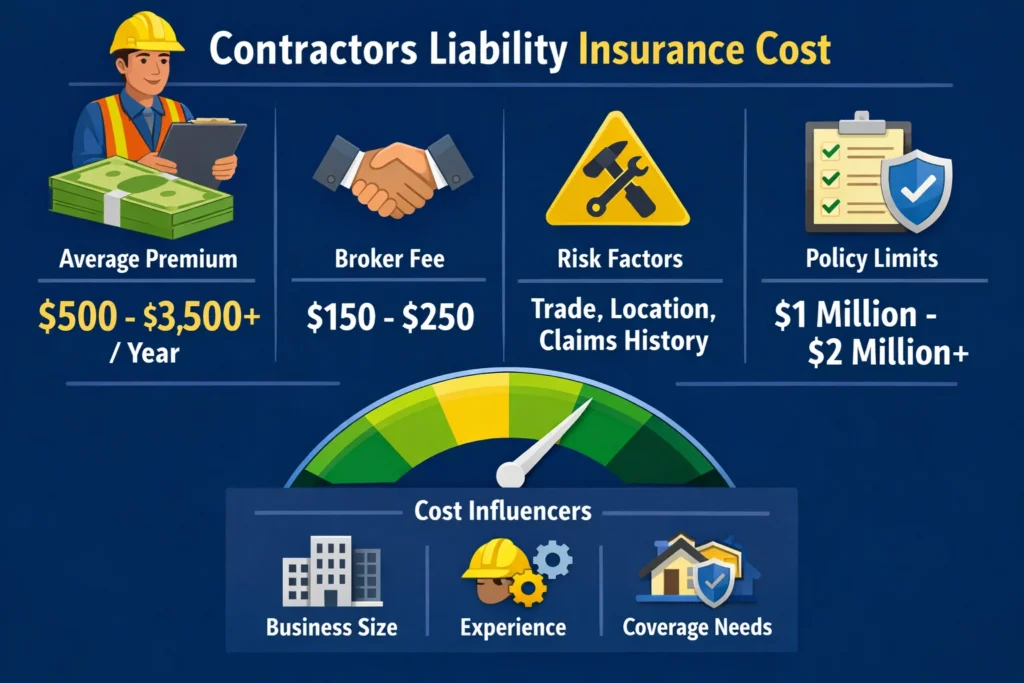
Contractor general liability insurance usually costs about $500 to $2,500+ per year for many small and mid-sized contractors, but the final price depends heavily on trade classification, payroll, claims history, coverage limits, and whether the policy is financed.
This page focuses specifically on what drives cost, what increases the total policy price, and how contractors can reduce premium.
Contractor General Liability Insurance Cost – Key Facts
- Typical Cost: $500 – $1,700/year for many small contractors
- Broader Range: $500 – $2,500+/year depending on risk and trade
- Monthly Cost: ~$40 – $150+ per month
- Common Limits: $1M per occurrence / $2M aggregate
- Pricing Based On: trade classification, payroll, claims history, and coverage limits
- Total Cost May Include: premium, broker fees, taxes, and financing charges
What Drives Contractor General Liability Insurance Cost?
Contractor general liability insurance pricing is based on risk. Insurers evaluate how likely a claim is and how severe that claim could be.
The most important factors that affect your premium include:
- Trade classification — higher-risk work like roofing, framing, or demolition typically costs more than lower-risk trades such as painting or finish carpentry
- Payroll and workforce size — more employees and larger payroll increase exposure and premium
- Claims history — prior losses can significantly increase pricing
- Business size and revenue — larger operations generally carry higher premiums
- Coverage limits — higher limits and added endorsements increase cost
In general, higher exposure equals higher premium.
What Makes Up the Total Cost of a Policy?
The price quoted by an insurance company is only part of the total cost. A contractor’s final policy cost may include several components:- Base premium — the core cost of the insurance policy
- Broker or agency fees — service fees for placing and managing the policy
- State premium taxes — required regulatory charges
- Surplus lines taxes and fees — applied for certain higher-risk policies
- Financing charges — added when paying in installments
Monthly Payments vs Paying in Full
Contractors can either pay the full premium upfront or finance the policy over time.- Pay in full: lowest total cost
- Financed payments: lower upfront cost, but higher total cost
- 20% – 25% down payment
- Remaining balance paid over 9–10 months
- Finance charges adding approximately 5% – 20%
Broker Fees Explained
Many contractor liability policies include a broker fee or service fee charged by the agency placing the coverage.- Typical range: $150 – $250 for many contractor policies
- Usually disclosed separately from the premium
- May vary based on policy size, complexity, and state regulations
Surplus Lines Taxes and Fees
If a policy is placed with a surplus lines insurer, additional state-required charges may apply.- Surplus lines premium tax
- Stamping or filing fees
- Regulatory assessments
Key Takeaway
The true cost of contractor general liability insurance is the total policy cost, not just the quoted premium. Before purchasing a policy, contractors should evaluate:- Base premium
- Broker or service fees
- Taxes and surplus lines charges
- Financing costs (if applicable)
General Liability Insurance Cost by Risk Level
| Contractor Risk Profile | Estimated Monthly Premium | Estimated Annual Premium | Typical Contractor Profile |
|---|---|---|---|
| Low Risk Contractor | $40 – $80 month | $480 – $960 year | Independent contractors, small trades with low injury risk such as painters, carpenters, or handymen. |
| Moderate Risk Contractor | $80 – $150 month | $960 – $1,800 year | Most general contractors, plumbers, landscapers, and HVAC contractors with small crews. |
| Higher Risk Contractor | $150 – $300+ month | $1,800 – $3,600+ year | Contractors with higher exposure such as roofers, structural contractors, paper contractors or businesses with multiple employees. |
Most small to mid-sized contractors pay between:
$500 to $3,500+ per year
However, pricing depends heavily on:
-
Trade classification
-
Annual revenue
-
Payroll size
-
Claims history
-
Years in business
-
Coverage limits selected
Higher-risk trades may pay significantly more, while low-risk contractors may qualify for lower premiums.
Summary: Average General Liability Insurance Cost by Trade
Insurance companies classify contractors by risk level. Certain classifications carry significantly more risk than others. Below are typical annual ranges for selected classes:
Electricians: $600–$1,500
Plumbers: $700–$1,800
HVAC Contractors: $750–$2,000
General Contractors: $800–$2,500
Roofers: $1,500–$4,000+
Framing Contractors: $1,200–$3,500
These are estimated ranges and vary based on underwriting factors.
What Changes Contractor GL Premium the Most?
-
Trade classification — roofers and framing contractors usually pay much more than painters or handymen
-
Payroll and subcontractor cost — larger labor exposure usually increases premium and audit risk
-
Claims history — prior losses often raise pricing sharply
-
Coverage limits — higher limits and umbrella layers increase premium
-
Additional insured and waiver requests — may increase cost depending on frequency and carrier
-
Business size and job type — commercial work, larger contracts, and higher hazard operations may price higher
How Contractors Can Lower General Liability Insurance Cost
-
Keep payroll and class codes accurate
-
Use only properly insured subcontractors
-
Maintain continuous prior coverage
-
Implement written safety procedures and jobsite documentation
-
Avoid small preventable claims when possible
-
Compare multiple carriers through a construction-focused broker
-
Pay annually when possible to avoid financing charges
Typical Cost by Contractor Size
-
Solo contractor / no employees: often lowest pricing tier
-
Small crew contractor: moderate premium due to higher jobsite exposure
-
Growing contractor with larger payroll: higher premium and more audit sensitivity
-
Larger contractor with multiple crews: significantly higher premium depending on trade and loss history
Have Contractor GL Costs Increased?
In general, yes. Contractor liability insurance costs have trended upward over time due to higher legal costs, construction defect claims, medical inflation, and tighter underwriting for high-risk classes. Roofers, framers, and other higher-hazard trades have generally seen larger increases than lower-risk trades.
Contractor Insurance Broker Fees Explained
When contractors purchase general liability insurance, the total cost of the policy usually includes a broker fees in addition to the insurance premium. Understanding how broker fees work helps contractors compare quotes and avoid unexpected charges.
What Is a Broker Fee?
A broker fee is a service fee charged by an insurance broker or agency for arranging the insurance policy. The fee compensates the broker for services such as:
-
comparing insurance carriers
-
preparing applications
-
negotiating coverage options
-
servicing the policy during the policy term including: additional insured requests, policy changes, certificate requests and servicing premium financed accounts among many broker provided services.
Broker fees are separate from the insurance premium, which is the amount charged by the insurance company for providing coverage.
Typical Broker Fee Range
Broker fees vary by agency and state regulations, but contractor general liability policies commonly include fees such as:
| Policy Premium | Typical Broker Fee |
|---|---|
| $500 – $1,000 | $150 – $250 |
| $1,000 – $2,500 | $250 – $350 |
| $2,500+ | $250 – $350 |
Some agencies charge a flat policy fee, while others calculate the fee as a percentage of the premium.
State Regulations on Broker Fees
Insurance broker fees are regulated in many states. Most states require brokers to:
-
disclose the fee to the customer
-
list the fee separately from the premium
-
obtain approval before charging the fee
These rules help ensure transparency when contractors purchase insurance coverage.
Broker Fees vs Insurance Premium
Contractors should understand the difference between the premium and broker fees.
| Cost Component | Description |
|---|---|
| Insurance Premium | The cost of the insurance coverage paid to the insurance company |
| Broker Fee | A service fee charged by the broker for placing the policy |
| Taxes & Surplus Lines Fees | Additional regulatory fees that may apply for certain policies |
A contractor’s total policy cost may include all three components.
Why Contractors Use Insurance Brokers
Many contractors choose to work with insurance brokers because brokers can:
-
compare quotes from multiple insurance companies
-
help select appropriate coverage limits
-
assist with certificates of insurance (COIs)
-
provide guidance on contractor risk exposures
Working with an experienced broker often helps contractors secure competitive coverage while ensuring the policy meets contract requirements.
Broker fees are a normal part of many contractor insurance transactions. While the insurance company sets the premium, brokers may charge a service fee for arranging and managing the policy. Contractors should review quotes carefully to understand the total cost of coverage, including premiums, broker fees, and any applicable taxes.
How Financing Affects the Cost of Contractor General Liability Insurance
1. The Base Insurance Premium
The base premium is the cost of the policy determined by the insurance company based on risk factors such as:
-
contractor trade classification
-
payroll and number of employees
-
claims history
-
coverage limits
-
years in business
Example base premium:
This amount does not change whether the policy is financed or paid in full.
2. Financing Adds Fees and Interest
If a contractor chooses financing, a premium finance company pays the insurer up front and the contractor repays the finance company in installments.
Typical financing structure:
| Payment Item | Example |
|---|---|
| Down payment | 20% – 25% |
| Monthly payments | Remaining balance over 9–10 months |
| Finance charge | ~5% – 20% of the premium |
Example:
| Item | Amount |
|---|---|
| Annual premium | $1,200 |
| Down payment (25%) | $300 |
| Financed amount | $900 |
| Finance fee | $90 |
| Total paid over time | $1,290 |
In this example, financing increases the cost by $90.
3. Why Contractors Use Financing
Many construction businesses prefer financing because it helps manage cash flow.
Benefits include:
-
lower upfront payment
-
easier budgeting with monthly payments
-
ability to maintain insurance coverage without large cash outlays
This can be especially helpful for:
-
new contractors
-
seasonal construction businesses
-
contractors carrying multiple insurance policies
4. Risks of Financing
Financing also comes with a few considerations.
If payments are missed:
-
the finance company may cancel the policy
-
cancellation can cause project delays
-
contractors may lose contract eligibility
Because of this, contractors should make sure monthly payments are manageable.
5. When Paying in Full May Save Money
Paying the full premium up front often results in the lowest total cost because it avoids finance charges.
Example comparison:
| Payment Method | Total Paid |
|---|---|
| Pay in full | $1,200 |
| Finance policy | $1,290 |
However, financing may still be worthwhile if preserving cash flow is important.
Key Takeaway
Financing contractor general liability insurance does not increase the base premium, but it adds finance charges that increase the total cost of the policy. Contractors who finance their insurance typically pay 5% to 15% more overall, depending on the financing terms.
Surplus Lines Taxes and Filing Fees
When a policy is placed with a surplus lines insurer, the state may require additional taxes and filing fees. These charges are mandated by law and paid to the state through the surplus lines filing system.
When Contractors May Need a Surplus Lines Policy
Many contractor general liability policies are written with standard admitted insurers. However, insurers sometimes place coverage with a surplus lines company when the contractor’s risk profile falls outside normal underwriting guidelines.
Common situations include:
High-Risk Construction Trades
Some trades carry higher injury or property damage risk, including:
-
roofing contractors
-
structural contractors
-
demolition contractors
-
foundation or framing contractors
Standard insurers may limit coverage for these trades, making surplus lines coverage necessary.
New Businesses With Limited History
Contractors who recently started their business may have:
-
no prior insurance history
-
limited financial records
-
limited project history
Surplus lines insurers often provide coverage when admitted insurers require more operating history.
Contractors With Prior Claims
If a contractor has experienced previous insurance claims, admitted insurers may decline coverage. Surplus lines insurers specialize in evaluating these higher-risk situations.
Specialized or Large Construction Projects
Projects involving:
-
unusual construction methods
-
large contract values
-
specialized building materials
may require custom coverage forms that surplus lines insurers can provide.
Why Surplus Lines Coverage Is Important
Without surplus lines insurers, many contractors would have difficulty obtaining liability coverage. These insurers play an important role in the construction insurance market because they provide coverage for risks that traditional insurers cannot or will not accept.
For contractors, surplus lines policies can:
-
make insurance available when standard carriers decline coverage
-
allow more flexible underwriting for specialized work
-
provide customized policy terms for complex construction risks
Most contractors purchase general liability insurance through standard admitted insurers. However, when a contractor operates in a higher-risk trade, has prior claims, or performs specialized work, the policy may be placed with a surplus lines insurer.
Although surplus lines policies may include additional taxes or filing fees, they provide an essential solution that allows contractors to obtain liability insurance and continue operating legally and safely.
Typical Surplus Lines charges include:
| Fee Type | Purpose |
|---|---|
| Surplus Lines Tax | Tax on the premium paid to the state |
| Stamping Office Fee | Administrative filing fee for the surplus lines transaction |
| Regulatory Assessment | Supports state insurance oversight |
These charges usually add 2% – 6% to the policy premium, depending on the state.
Example:
| Policy Item | Amount |
|---|---|
| Base Premium | $1,200 |
| Surplus Lines Tax (3%) | $36 |
| Stamping Fee | $15 |
| Total Policy Cost | $1,251 |
Why These Fees Exist
State governments require these taxes and filing fees to:
-
regulate insurance markets
-
protect consumers
-
monitor surplus lines transactions
-
ensure insurers operate within state law
Because these fees are required by law, all brokers and insurance providers must charge them when applicable.
Key Takeaway for Contractors
Taxes and surplus lines fees are government-mandated charges added to certain insurance policies. These fees are separate from the insurance premium and broker fees, and they typically increase the total policy cost by a small percentage.
Contractors should review insurance quotes carefully so they understand the complete policy cost, including:
-
insurance premium
-
broker or service fees
-
state taxes
-
surplus lines filing fees (if applicable)
Understanding these charges helps contractors compare quotes accurately and avoid surprises when purchasing liability insurance.
Why Final Cost Can Be Higher Than the Original Quote
Contractor GL policies are often quoted using estimated payroll, revenue, and subcontractor cost. If your actual numbers come in higher at audit, the insurer may bill additional premium.
Common reasons final cost increases:
-
payroll higher than estimated
-
uninsured subcontractors
-
misclassified work
-
revenue growth during the policy term
This is strong cost-cluster content.
Get a Fast General Liability Insurance Quote
To receive a contractor general liability insurance quote, you typically need:
-
Business name and structure
-
Years in operation
-
Estimated annual revenue
-
Payroll information
-
Description of work performed
-
Prior claims history
Many contractors can receive same-day approval and proof of insurance.
Contractor Liability Insurance Cost – FAQ
How much does contractor general liability insurance cost?
Many small contractors pay approximately $500 to $3,500+ per year for general liability insurance. The total cost depends on trade classification, payroll, claims history, coverage limits, business size, and location.
What affects the cost of contractor liability insurance?
Insurance companies calculate contractor liability insurance premiums based on several factors, including the type of construction work performed, payroll, number of employees, years in business, claims history, revenue, and policy limits. Higher-risk trades usually pay more.
Do contractor insurance quotes include broker fees?
Sometimes. In addition to the insurance premium, some contractors also pay broker or service fees, which commonly range from $150 to $250 depending on the agency, state rules, and policy complexity.
Does financing increase the total cost of contractor liability insurance?
Yes. Financing does not increase the base premium, but it does increase the total cost of the policy because premium finance companies charge interest or service fees. Many financing plans add approximately 5% to 15% to the financed amount.
What are surplus lines fees in contractor liability insurance?
If a contractor’s liability policy is placed with a surplus lines insurer, the total cost may include additional state-mandated taxes and filing fees. These charges often add approximately 2% to 6% to the premium, depending on the state and policy type.
What is the total cost of contractor liability insurance?
The total cost of contractor liability insurance may include the base premium, broker fees, financing charges, and state taxes or surplus lines fees. Contractors should review quotes carefully to understand the full cost of coverage before purchasing a policy.
Additional Contractor Insurance and Bond Products
Contractors often need multiple types of insurance and bonding to meet licensing requirements and project contract obligations. The following products are commonly purchased together with contractor general liability insurance.
Contractor License Bonds
Many states require contractors to maintain a contractor license bond to obtain or maintain an active contractor license. Bond amounts and requirements vary by state.
Learn more:
https://website.mybondline.com/contractor-license-bonds/
Contractor General Liability Insurance
General liability insurance protects contractors from third-party bodily injury, property damage, and advertising injury claims that may occur during construction operations.
Learn more:
https://website.mybondline.com/contractor-general-liability-insurance/
Contractor Workers’ Compensation Insurance
Workers’ compensation insurance covers medical expenses and lost wages for employees who are injured while working. Most states require contractors with employees to carry workers’ compensation coverage.
Learn more:
https://website.mybondline.com/workers-compensation-insurance/
Contract Bonds (Bid, Performance, and Payment Bonds)
Many public works and large commercial construction projects require contract bonds to guarantee that the contractor will complete the project according to the contract terms.
Learn more:
https://website.mybondline.com/contract-bonds/
Related Pages:
Contractor General Liability Insurance: Cost, Coverage & Requirements (2026 Guide)
Reviewed by: Jeremy Schaedler
Principal – Mybondline Insurance Services
As principal at Mybondline, Jeremy Schaedler has specialized in contractor license bonds and construction insurance since 2006. CA License: 0f06277
This information is for general informational purposes only and does not constitute legal advice. Licensing and insurance requirements may change. Contractors should verify current requirements directly with their state regulatory agency or consult qualified legal counsel.

Jeremy Schaedler
Shortly after graduating from the University of California, Los Angeles with a bachelors degree in economics, Jeremy founded Surety First Insurance Services (formerly Schaedler Insurance), a Northern California based insurance agency specializing in surety bonds for California construction professionals. Jeremy is happily married and the proud father of two young boys. In his free time, he enjoys camping, fishing and shooting the breeze with friends and family.
Issued Through A-Rated National Surety & Insurance Carriers
Approved by contractor state licensing boards in CA, Or, WA, NV & AZ









See Why Thousands of Contractors Choose My Bondline
100% Money Back Guarantee
We guarantee our bonds will be accepted by the obligee or we’ll refund your money. See details.
Expedited Shipping Available
Many bonds can be printed online directly after purchase and expedited shipping is available for others.
Thousands of Satisfied Customers
Since starting in 2006, we’ve bonded thousands of successful small businesses just like yours.
Trusted by 20,000+ Contractors Since 2006
Trustindex verifies that the original source of the review is Google. Surety First provided us with outstanding customer service. The level of professionalism and ease in process was above and beyond. Highly recommend this company.Posted on GoogleTrustindex verifies that the original source of the review is Google. I've had a great experience with Surety. The office staff is always very helpful and don't waste any time. I have my bond through them and every time I need to renew it it's hassle free and like 5 minutes over the phone. Their prices are good, and they are local. Thank you guys!Posted on GoogleTrustindex verifies that the original source of the review is Google. I'm experience working with Chrissie and team was amazing. The process was fast and easy, took care of everything I needed. I'm referring everyone I know for their services. Thank you again.Posted on GoogleTrustindex verifies that the original source of the review is Google. Chrissie was extremely helpful and attentive getting the bonds I needed for licensing. I highly recommend Chrissie and the Surety First team for prompt and professional bonding solutions.Posted on GoogleTrustindex verifies that the original source of the review is Google. As a new business, Chrissie helped me get all my bonds and insurance needed to be in compliance with the state at an affordable price. Also, Kelsey was very helpful in fixing a mistake I had done on my behalf. I highly recommend Surety for all your bonds/insurance needs.Posted on GoogleTrustindex verifies that the original source of the review is Google. Chrissie and Surety First have been a pleasure to work with. The pricing for insurance is fair and the customer service I received from Chrissie was exceptional. I will be renewing my policy thru them annually from here on out.Posted on GoogleTrustindex verifies that the original source of the review is Google. Great experience and would do business with again. Chrissie was amazing in finding the best quote for my company.Posted on Google